The Bingo Hall Has a Boss Fight Now: Inside Britain's Care Home Playtests
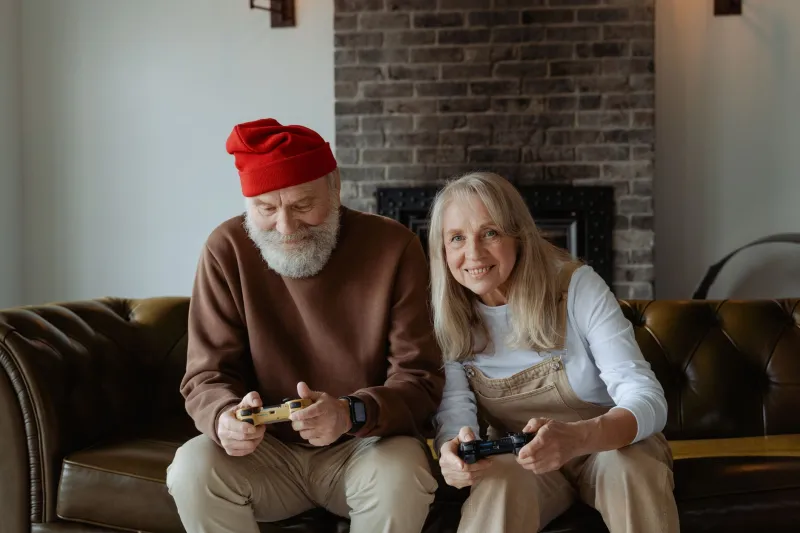
There is a particular sound that fills a care home lounge when a racing game starts: the low murmur of residents deciding who is taking the good controller, followed by a burst of laughter when someone drives straight into a wall. It is not the sound most people associate with video games in 2026, but it is becoming more common. Across Britain, care homes and community centres are trialling consoles, motion games and stripped-back controllers not as entertainment for staff to wheel out on a rainy afternoon, but as social prescriptions for isolation.
From Activity Hour to Playtest Session
The phrase social prescribing gets used a lot in UK health circles. It usually means connecting people to community groups, gardening, walking football or arts sessions rather than relying solely on clinical care. Games are now edging into that space. Charities and local authorities are funding small pilots that put co-op consoles into communal rooms, often with staff on hand to help. The aim is simple: give people a reason to sit next to each other and do something together that is not bingo or television.
What makes this more interesting than a novelty activity is the feedback loop. Care home staff are not just running sessions; they are watching how people interact with the technology. Which controller gets picked up first? Where does someone get stuck? What causes frustration, and what causes a second round? That information is quietly turning these lounges into test labs for the industry.
What Older Players Actually Want
The assumption is often that older players want gentle puzzle games or virtual bowls. Some do. But spend time in these sessions and a messier picture emerges. People want banter, competition and a sense of progress. A simple golf game can fall flat if it feels like a hospital activity. A chaotic kart racer can work brilliantly if the controls are forgiving and the room is loud enough.
There is also a strong preference for co-operation over competition. Games that let one person steer while another shouts directions, or where a shared score matters more than individual victory, tend to keep people engaged. That is not because older players are fragile. It is because the social side is the point. The game is the excuse to talk.
The Controller Problem Is Still the Controller Problem
Accessibility has moved up the agenda in recent years, but care home trials expose how much of it assumes a certain kind of player. Tiny buttons, layered menus and twin-stick controls remain barriers. Motion controls can help, but only if they are optional and calibrated for people who may be seated. Simplified controllers and adaptive switches are promising, yet they are often expensive or hard to source for a communal setting.
This is where the pensioner playtesting idea gets useful. Studios usually test with younger players or accessibility consultants who know the theory. Care home sessions offer something different: a group of people with varied eyesight, hearing, mobility and patience, all in one room. If a menu confuses them, it will probably confuse plenty of other people too. If a tutorial loses their attention in ninety seconds, that is worth knowing.
What UK Studios and Charities Are Watching
A handful of UK developers and charities are already paying attention. Accessibility specialists have long argued that designing for older players overlaps heavily with designing for disabled players: clearer text, remappable controls, flexible difficulty and fewer assumptions about reaction times. The care home setting adds a social layer. It asks whether a game can be understood by someone watching from the sofa, not just the person holding the pad.
Charities focused on loneliness and digital inclusion are also circling. The interest is not purely altruistic. Games companies are facing a demographic cliff of their own, with younger audiences split across more platforms and more distractions. Older players are a growing market, but they are not a monolith. Treating them as one is the fastest way to fail.
The Limits of the Lab
It would be easy to overstate this. Care homes are not a substitute for proper user research, and a dozen sessions in a few lounges do not add up to a national trend. Staff time is stretched. Hardware gets broken. Wi-Fi drops. Some residents have no interest in games and should not be pushed. The pilots that work tend to be the ones that treat gaming as one option among many, not a miracle cure for isolation.
There is also a risk of patronising the audience. Older players do not need games designed to be worthy or educational. They need games that are fun, readable and respectful of their time. The best sessions are not therapy sessions with a controller attached. They are just good games played by people who happen to be over seventy.
Why This Matters Beyond the Care Home
For an industry obsessed with the next headset or the next subscription tier, the care home trial is a useful corrective. It shows that innovation is not always a new gadget. Sometimes it is a stripped-back controller, a clearer menu and a game that works when four people are talking over it. It also shows that the UK's games culture is broader than the teenage bedroom or the esports arena. It includes community halls, sheltered housing and a generation that grew up with Space Invaders and still fancies a go.
In 2026, the most interesting playtest in Britain might not be in a glass-walled studio in London or Dundee. It might be in a lounge in Leeds, with a plate of biscuits, a dodgy projector and someone asking whether the blue car is faster. If the industry is smart, it will listen.